

Enshittification and the pyramid of cuts
Read the original in Spanish →
I do not know when we swallowed the idea that this was normal.
A company announces “record profits” with one hand, and with the other hands you an ERE—a collective redundancy procedure in Spain—freezes your pay, or tells you that “this year we need to tighten our belts.”
And I am not talking about a small business struggling to survive. I mean the usual suspects. The ones at the very top. IBEX companies, telecoms, banks, energy companies. The ones making headlines whenever it is time to talk about “efficiency” and “transformation.”
Lately, I keep coming back to an idea that disgusts me because it describes things so precisely: enshittification. In Spanish, mierdificación. The process by which something does not break overnight, but works a little worse for almost everyone, year after year. No drama. No headline. No big bang. Just a slow decline.
What bothers me is that, while we feel that deterioration every day, the bottom line at the top usually improves. Not by coincidence, either. More like a sign that the system was designed for exactly this to happen.
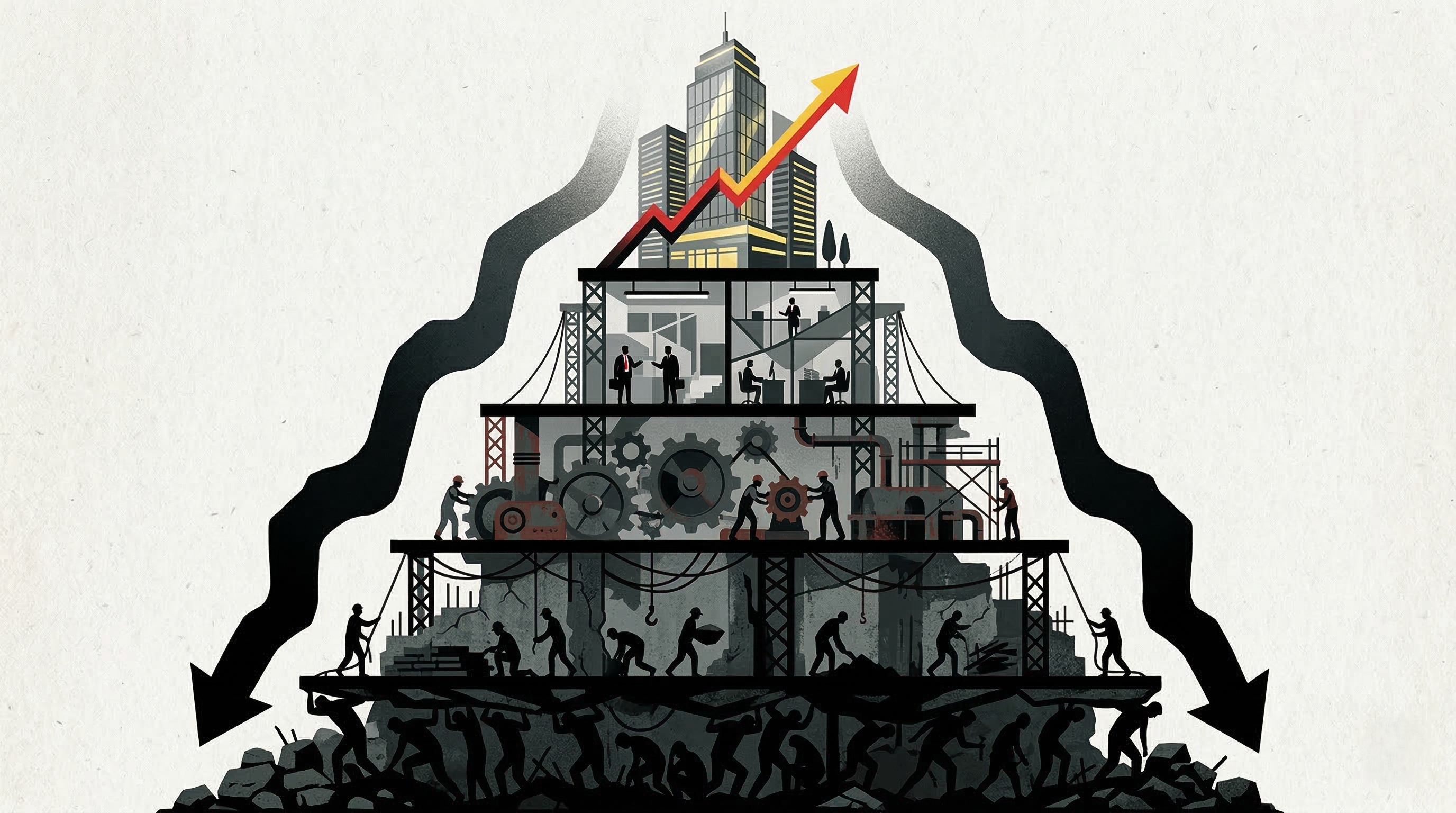
In Spain, it is easy to see if you picture a pyramid. The big companies sit at the top. Below them, consultancies and integrators. Below those, subcontractors. Then subcontractors of subcontractors. At the bottom, the people who actually keep the service running: the ones opening up every morning so that “everything works.”
Here is the perverse part: cuts travel downwards by gravity. Nobody needs to plan it with malicious intent. It happens by itself. At the top, they cut budgets. In the middle, those cuts become demands and “reformulations.” By the time they reach the bottom, they are no longer a number: they are pay, working conditions, pressure, staff turnover. Real life.
That is why, when someone asks, “how can there be profits and layoffs at the same time?”, it no longer sounds like a contradiction to me. It sounds consistent. A model doing exactly what it was designed to do.
Outsourcing is a key part of that machine. It comes wrapped in the attractive language of “flexibility”, “partners”, and “ecosystems”… but often it is a shredder of responsibility. When something goes wrong, nobody owns it. Everyone is “a little responsible.” In the end, the last link in the chain gets stuck with the whole mess. No power. No room to maneuver. But a real person left to face it.
What happens at the bottom does not appear in presentations. It appears in corridors and chats: burned-out people, people leaving, knowledge disappearing. Services kept alive by heroic effort and patches. Quality falling while the KPI gets dressed up to suggest that everything is fine.
The worst part is that it does not happen all at once. It accumulates. Month by month. Quarter by quarter. As if the entire country were being run through monthly closes and PowerPoint decks.
I do not know. I get the feeling that a country cannot build well-being if those at the top grow by squeezing their own supply chain. That is not competition. That is eating the future one spoonful at a time.
Where do you notice it most: telecoms, banking, energy… or the public sector?